OK. This is far to long for a blog post but there is a lot of information to communicate; so bear with me.
Whilst being unable to attend the most recent Oracle Open World Event due to a
bike accident , I was able to listen to the keynotes live on the Internet as well as review the concurrent press releases and blog postings.
There was a lot of good information delivered through the speakers. Below are what I consider to be the highlights from OOW 2006.
Links to my summaries of the TOP 5 Keynote speeches1.
Phillips; OpenWorld Keynote Kickoff2.
Ellison Announces Enterprise-Class Support Program for Linux3.
Wookey Outlines Applications' Progress and Charts Their Future (includes Fusion demo)4.
Kurian Unveils Oracle WebCenter5.
Rowzat; Meeting the Business Intelligence Crisis with Oracle TechnologyOther interesting topics1.
Identity ManagementLinks to Oracle Identity Management offeringsAt Macerich we looked at Oracle Identity Management solutions earlier this year, including a set of presentations and demos. Clearly the solutions and functionality are a good fit with our requirements and future direction. Most of the components in this stack are comprised of software solutions acquired by Oracle over the past year. Given the number of projects currently under way it was decided to deal only with the Single-Sign-On component in 2006 and address other components at the end of Q1 2007. This would also give Oracle time to more seamlessly integrate these newly acquired products.
Over the course of the last 6 months I have posted a number of Identity Management related articles on my Macerich-Oracle blog. Here is a listing of those articles:
Synchronizing Oracle HRMS with OIDPassword Management with OIDUsing Third Party Identity Managers with EBusiness Suite 11iPassword Management with Third Party SolutionsAliases Maiden Names and NicknamesCOREid, Thor, Xellerate and OthersBack to Top 2. Ten Things You Can Do To Prepare for Fusion Applications
Although Fusion Applications are years away, there are many components of Fusion Middleware that are available today to help get us one step closer to Fusion Applications. The message from John Wookey, Cliff Godwin, Nadia Bendjedou, and others regarding Release 12, Fusion Middleware, and Fusion Applications remains consistent - we don’t need to wait for the release of Fusion Applications to start preparing for Fusion.
Moving to Fusion Applications will require new skills and experience to install, configure and support the new Applications Suite. However, many of the tools and technologies for Fusion Applications are available today and can be leveraged with 11i10 and/or Release 12, allowing us to get a head start on preparing our environment and staff for Fusion Apps.
Dr. Nadia Bendjedou’s session “Oracle E-Business Suite Customers: 10 Things You Can Do Now to Prepare for Oracle Fusion Applications” was still standing room only for some despite the fact the room held almost 500 people. There is obviously a lot of interest in Fusion, and the good news is we don’t have to wait years to start preparing today. Nadia’s presentation focused on both best practices as well as product components, and listed 10 items e-Business Suite customers should start focusing on now:
Dr. Bendjedou's Top 10 List
- Rethink your customization strategy
- Consider Master Data Management (MDM)
- Move to SOA-based integration
- Extend your business intelligence portfolio
- Adopt enterprise reporting and publishing
- Secure your global enterprise
- Deploy grid computing
- Centralize your lifecycle management
- Upgrade to the e-Business Suite R12
- Prepare a Fusion project plan
Back to Top 1. Phillips; OpenWorld Keynote Kickoff
(5 min. audio summary) Oracle President Charles Phillips announced Oracle's business strategies for
grid computing,
Oracle Fusion Middleware, and applications. Mr. Phillips also discusses Oracle's acquisitions,
Oracle Accelerate, and the enterprise
software ownership experience (PDF).
Back to Top 2. Ellison Announces Enterprise-Class Support Program for Linux
(5 min. audio summary) Addressing the largest crowd in Oracle OpenWorld history, Oracle CEO Larry Ellison unveiled Oracle Unbreakable Linux.
Link to brief summary of Mr. Ellison's keynote.Quotes from Mr. Ellison's keynote:- "Oracle's new Unbreakable Linux program will provide bug fixes to future, current, and back releases of Linux"
- "the new support program is available for all Linux users for as little as $99 per system per year;
until January 31, 2007"
- "Oracle customers can get a free trial, and anyone can purchase support at a 50-percent discount"
- "..all you have to do is point your Red Hat server to the Oracle network; switching takes less than a minute"
- "We think it's important not to fragment the market, and we will maintain compatibility with Red Hat Linux,..we will resynchronize with their code"
Back to Top 3. Wookey Outlines Applications' Progress and Charts Their Future
(5 min. audio summary) Link to brief summary of Mr. Wookey's keynoteMr. Wookey reiterated Oracle's Applications Unlimited initiative. Mr. Ellison later stated that maintaining all of these Applications Suite was not a problem. Oracle could afford it as long as customers wanted it. He believes that within 10 years the demand for these legacy suites will have waned.
He also discussed the following topics:
a. The improved user experience within Oracle E-Business Suite Release 12
b. Four concepts that drive thinking about the next generation of Oracle applications:
- secure enterprise search, which is the new metaphor for navigating applications;
- XML-based reporting, which allows reports to be customized in countless ways;
- role-based analytics, a concept taken from Siebel products, which places business insight into the context of operational systems;
- sustainable integration, or connecting all products to one another and to third-party applications. To highlight this last point, he announced the creation of Oracle's Adaptive Business Solutions Group, which is dedicated to applications integration.
c. Oracle Fusion, its time line, and the four technologies that enable it:
- Web 2.0 concepts, such as desktop and collaboration tools;
- Service-oriented architecture (SOA), which gives businesses flexibility in how they develop and deliver business processes;
- Middleware, which orchestrates those processes;
- Standards, which provide Oracle, its partners, and its customers with common, shared tools for doing all of the above.
d.
One of the biggest highlights of the entire Open World event for me was the demonstration which provided the first glimpse of Fusion Applications during Mr. Wooskey's keynote address. Jeremy Ashley from the Applications User Experience group walked through a scenario where a sales rep uses Fusion Apps to prepare a quote, ultimately leading to a closed sale.
Here is a link to the screen shots from the demo.Back to Top 4. Kurian Unveils Oracle WebCenter
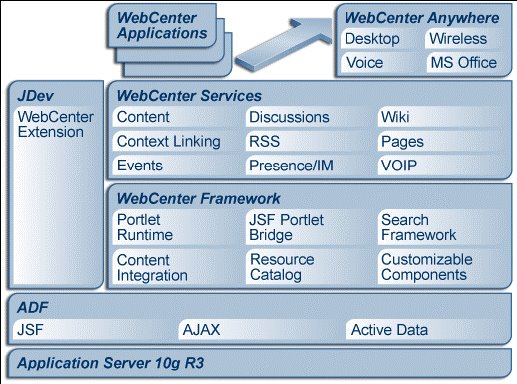
(4 min. audio summary) Link to summary of Mr. Kurian's keynoteMr. Kurian discussed how Oracle WebCenter will provide a way to build sophisticated Web 2.0-based user interaction environments, and deliver task-oriented, contextual, multichannel interactions for users. "[Web 2.0] technologies are fundamentally changing how people interact with information on the Internet", he said. "WebCenter is used to streamline and automate tasks that involve jumping between different applications and tools that don't share content or context." The new set of tools, which is based on a service-oriented architecture, will enable companies to build applications that bring together data from various enterprise applications such as CRM, ERP, Microsoft Office desktop and mobile devices.
Kurian identified a number of other processes of Oracle Fusion Middleware's software:
- service-oriented development of applications
- business process management
- secure identity management
He also announced the next release of Oracle's open, standards-based suite of business intelligence products: Business Intelligence Suite Enterprise Edition 10g Release 3
Back to Top 5. Meeting the Business Intelligence Crisis with Oracle Technology
(5 min. audio summary) Link to Mr. Rozwat's Keynote summaryChuck Rozwat announced Oracle Database 11
g and its 482 new features. Rozwat also reviewed a cross section of Oracle technology that helps customers address the issues associated with getting a single view of information, customers, and suppliers, including Oracle Content Database 10
g, Oracle Records Database 10
g, Oracle Secure Enterprise Search 10
g, and Oracle Audit Vault 10
g, articulating how these products help companies' CIOs and IT directors manage content across the enterprise.
Back to Top
2. Ellison Announces Enterprise-Class Support Program for Linux
Addressing the largest crowd in Oracle OpenWorld history, Oracle CEO Larry Ellison unveiled Oracle Unbreakable Linux, a new support program for Linux that provides the same enterprise-class support for Linux that Oracle provides for its database, middleware, and applications products.
"Currently, Red Hat only provides bug fixes for the latest version of its software. This often requires customers to upgrade to a new version of Linux software to get a bug fixed," explained Ellison. "Oracle's new Unbreakable Linux program will provide bug fixes to future, current, and back releases of Linux. In other words, Oracle will provide the same level of enterprise support for Linux as is available for other operating systems."
Better Support, Lower Cost
Oracle is offering its Unbreakable Linux program for substantially less than Red Hat currently charges for its best support. Ellison explained that the new support program is available for all Linux users for as little as $99 per system per year; until January 31, 2007, Oracle customers can get a free trial, and anyone can purchase support at a 50-percent discount. "This is all about broadening the success of Linux," added Ellison. "And to get Oracle support for Red Hat Linux, all you have to do is point your Red Hat server to the Oracle network; switching takes less than a minute."
Midway through his keynote, Ellison invited Edward Screven, Oracle chief corporate architect, and Wim Coekaerts, vice president of Linux engineering, to join him on stage.
"We think it's important not to fragment the market, and we will maintain compatibility with Red Hat Linux," said Screven. "Every time Red Hat distributes a new version, we will resynchronize with their code. All we add are bug fixes, which are immediately available to Red Hat and the rest of the community."
Coekaerts concurred. "We have many years of Linux engineering experience and an excellent technical team solely dedicated to Linux," said Coekaerts. "In fact, several Oracle employees are Linux mainline maintainers, and Oracle has a long history of contributing to the community." Oracle's breadth and depth of technical expertise, advanced support technologies, and global reach includes 7,000 support staff in 17 global support centers, providing help to Oracle customers in 27 languages, in any time zone.
Screven echoed Ellison's assertion that true enterprise-quality support for Linux at a lower cost is something that customers demand, and a long list of customers and partners have already endorsed Oracle's new Linux support program. Yahoo! Vice President of Engineering Laurie Mann took the keynote stage to share his company's enthusiasm for Oracle Unbreakable Linux. Mann explained that Yahoo!, which runs Oracle and Linux, is the most visited home page on the Web, so reliability and support are paramount. Oracle's enterprise-class support program addresses this demand head-on.
Many more customers and partners appeared via video on the massive screens in the keynote hall, including Dell, Intel, HP, IBM, Accenture, AMD, BearingPoint, EMC, BMC Software, Network Appliance, and many others. Toward the keynote conclusion, the audience was treated to Oracle's version of "The March of the Penguins," as several live penguins (accompanied by their professional trainers) waddled on stage.
Back to Top
3. Wookey Outlines Applications' Progress and Charts Their Future
Now I know why security apparently worked extra-hard to keep aisles clear during the Wednesday morning keynote.
A few minutes into his talk, Oracle Senior Vice President John Wookey said, "Continuing our tradition of having sexy Italian companies present with me at Oracle Openworld, I'm very excited to introduce and welcome Ducati Motorcycles." A roar came from the back of the hall, and two gleaming Ducati bikes raced up the aisles and onto the stage.
Answering the question of why Ducati chose Oracle E-Business Suite, Giovanni Contino, Ducati Consulting CEO, joked that Oracle and Ducati have the same red color in their logos. But the real reason, he said, was that Oracle Applications adapted to his business. Contino then showed how Oracle E-Business Suite had helped Ducati become a "lean ride" and how the company had ridden Oracle-powered Lean processes to an International Best Factory Award (from the U.K.-based Cranfield School of Management) in just three years.
While the motorcycles were impressive, Oracle's Applications Unlimited initiative was the real high-powered machine in the room. Wookey reiterated Oracle's plans to support and enhance all of its application lines. "The commitment is very real," Wookey said. "We have dedicated development teams and dedicated leadership across product lines that are absolutely passionate about them, and passionate about working with customers to make sure we continually improve how we support you, how we continue to enhance the product with new features, and how we bring innovation and next-generation technology into those product lines."
Indeed, the needs and desires of customers drive Oracle's efforts in applications development. Wookey discussed the countless hours that Oracle applications teams have spent interviewing, surveying, and learning from customers in order to determine how they work and how—they want to work--and then plowed that information back into the applications.
Wookey also emphasized that major new releases are planned in all application product lines. "In fact, the new release of [JD Edwards] World is the first major functional release of the product since 1998," he pointed out.
Oracle's acquisition of applications companies has allowed it to take the best elements of each of its application lines and incorporate them into other applications. "We're bringing great intellectual property out of these product lines, across [to] other product lines, and into our next generation of applications," Wookey said.
Take, for example, the task-based user interface pioneered by Siebel. "It's a great idea, and something we think Siebel customers will be very excited about," Wookey said. "But we think it's something everyone can benefit from, so it's one of the design principles from a user-interface perspective that's actually getting architected into Fusion applications."
Wookey discussed the new Oracle E-Business Suite Release 12. Improvements include tailored installation scripts that customize upgrades that minimize upgrade interruption, and the application's improved user experience. "We've benefited from a lot of great [intellectual property] that's come into Oracle from PeopleSoft and Siebel," he said. "They had done a lot of great work on usability design, and we've actually taken advantage of that in all of our product lines, certainly in the [Oracle] E-Business Suite Release 12."
Turning an eye to the future, four concepts drive thinking about the next generation of Oracle applications, according to Wookey:
a. secure enterprise search, which is the new metaphor for navigating applications;
b. XML-based reporting, which allows reports to be customized in countless ways;
c. role-based analytics, a concept taken from Siebel products, which places business insight into the context of operational systems;
d. sustainable integration, or connecting all products to one another and to third-party applications. To highlight this last point, he announced the creation of Oracle's Adaptive Business Solutions Group, which is dedicated to applications integration.
Lastly, Wookey spent a few minutes discussing Oracle Fusion, its timeline, and the four technologies that enable it:
a. Web 2.0 concepts, such as desktop and collaboration tools;
b. service-oriented architecture (SOA), which gives businesses flexibility in how they develop and deliver business processes;
c. middleware, which orchestrates those processes;
d. standards, which provide Oracle, its partners, and its customers with common, shared tools for doing all of the above.
"That's what really brings the promise of SOA home," Wookey said, "the idea that there are accessible tools that we've used to build the system that you have equal access to."
Back to Top
4. Kurian Unveils Oracle WebCenter
Heralding the first user interaction environment to break down the boundaries between Web-based portals, enterprise applications, and Web 2.0 technologies, Thomas Kurian, senior vice president of development for middleware platform products delivered his keynote address, called "The Middleware Revolution," at Oracle OpenWorld on Tuesday morning.
Kurian announced a new product of Oracle Fusion Middleware called Oracle WebCenter Suite, which will provide a way to build sophisticated Web 2.0-based user interaction environments, and deliver task-oriented, contextual, multichannel interactions for users.
"[Web 2.0] technologies are fundamentally changing how people interact with information on the Internet. We're bringing those technologies to you, the enterprise application community, and to people who want to build applications that use Web tool technologies within their corporate enterprise," said Kurian.
Customers can use WebCenter to streamline and automate tasks that involve jumping between different applications and tools that don't share content or context. WebCenter also creates a more dynamic, interactive work environment by deploying the new wave of Web 2.0 technologies, such as mashups, wikis, Voice over IP, RSS feeds, and discussion forums, across the enterprise.
The new set of tools, which is based on a service-oriented architecture, will enable companies to build applications that bring together data from various enterprise applications such as customer relationship management (CRM) and enterprise resource management (ERP). Because it is hot-pluggable and based on open industry standards, users can also access this environment from other environments, such as Microsoft Office desktop and mobile devices.
"Only Oracle WebCenter Suite enables a superior user experience based on a full set of enterprise services that are pre-integrated and based on open industry standards," said Kurian.
Kurian identified a number of other processes of Oracle Fusion Middleware's software that companies can use to streamline business operations and improve information technology flexibility. These include service-oriented development of applications, business process management, and secure identity management.
He also announced the next release of Oracle's open, standards-based suite of business intelligence products: Business Intelligence Suite Enterprise Edition 10g Release 3, which includes new components and improvements, allows for strategic integration with other Oracle products, and has expandable hot-pluggable support for third-party data sources and systems.
"Fusion Middleware has grown from virtually nothing in 2001 to over a billion dollars in just five years. Thirty-one thousand global companies use Fusion Middleware today," said Kurian. "The Internet continues to transform the architecture of enterprise applications. Fusion Middleware gives you the best middleware suite in the industry to exploit that transformation."
Back to Top
5. Meeting the Business Intelligence Crisis with Oracle Technology
Chuck Rozwat, Oracle's executive vice president of Server Technologies, outlined Oracle's vision for its key technologies and provided some details on the company's product road map in a Monday morning keynote speech at Oracle OpenWorld, titled "The Information Road Map: What's Next?"
"We have a business intelligence crisis in the midst of our content data crisis," Rozwat told the crowd. "Most companies have a collection of different applications, so getting a single view of information, customers, and suppliers can be difficult."
In addition to the announcement of Oracle Database 11g and its 482 new features, Rozwat reviewed a cross section of Oracle technology that helps customers address those issues, including Oracle Content Database 10g, Oracle Records Database 10g, Oracle Secure Enterprise Search 10g, and Oracle Audit Vault 10g, articulating how these products help companies' CIOs and IT directors manage content across the enterprise.
In addition to listing Oracle's range of products, Rozwat discussed several of Oracle's recent acquisitions and how those companies' solutions bolster Oracle's technology road map. A representative from TimesTen helped to illustrate the point, explaining in a video presentation how TimesTen's real-time data caching solution works with Oracle Database.
A theme of Rozwat's keynote was the belief that evolving and expanding information requires businesses of all sizes to embrace a road map for managing important content and data in a secure, reliable, and cost-effective way. Oracle software, using advanced grid computing technology, adapts to a company's changing business needs, Rozwat emphasized.
"As data volumes increase, stress is being put on existing computing resources. The ability to scale is incredibly important, and you need an architecture that allows you to plug in more servers," said Rozwat. "Grid computing has grown over the years because of this."
Rozwat described the information explosion from both the demand side, which includes user demands and needs, and the supply side, examining how companies struggle to bring all this information to users in an integrated way.
"The amount of information that's being generated is truly incredible," he said. "However, the demands on how we use information can turn an asset into a liability. Oracle has new solutions to harness this information explosion."
Rozwat concluded by detailing Oracle's vision for its key technologies and outlining a specific strategy for the future of Oracle products, including Oracle Database, Oracle Fusion Middleware, Oracle's development products, and Oracle Grid Computing.
Back to Top
Oracle Identity Management: Best-in-Class. Application Centric. Hot-Pluggable.
Oracle Identity Management's best-in-class suite of IdM solutions delivers
hot-pluggable middleware, allowing enterprises to manage the end-to-end life cycle of user identities across all enterprise resources both within and beyond the firewall. One can now deploy applications faster, apply the most granular protection to enterprise resources, automatically eliminate latent access privileges, and much more.
Oracle Identity management is leading the next wave of Identity Management with an
Application-Centric approach.
Read more about
best-in-class Oracle Identity Management solutions:
Back to Top